Australia is often referred to as the sunburnt country, and your sunburns endorse this fact. Can’t agree more, right? On a positive side, the extraordinary abundance of solar energy makes the use of solar technology a mainstream, practical, and economically wise move for homeowners and businesses alike. With rising electricity costs, a growing environmental consciousness among citizens, and supportive government incentives, installing solar panels or tiles has moved from an option to a practical and economically viable enhancement for modern properties.
As of 15th December 2025, a total of 4.264 million solar power systems have been installed on Australian homes and small businesses. ( Source )
Definitely, the clean energy revolution is unfolding, powered by the sun.
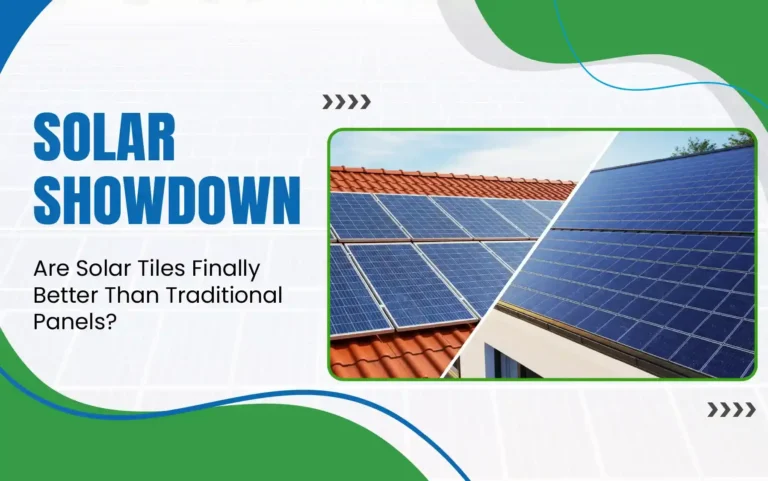
Solar electric roof has become a necessity of the hour. We are in consensus! Now the next question arises: what to choose, solar panels or solar roof tiles? Which is the better choice in terms of efficiency, cost-effectiveness, and as an overall long-term investment? Homeowners and commercial enterprises now have more options than ever, with solar roof tiles emerging as a viable alternative to traditional solar panels. Both solar panels and solar tiles convert sunlight into electricity, reducing dependence on fossil fuels and cutting greenhouse gas (GHG) emissions and supporting solar and sustainability goals for homes and the planet.
Wondering what’s the best choice? Let’s dive deep into these solar solutions.
Read More: On-Grid vs Off-Grid Solar: Which Is Best for Your Australian Business?
Solar Panels
Solar Panels are the most common and cost-effective option, offering higher efficiency rates and a lower initial investment. They consist of PV cells arranged in modules, usually called as panels, that are mounted onto a rooftop or ground-mounted system. These panels are typically installed using racks or frames that angle them optimally toward the sun to maximise efficiency. Solar panels have been the obvious choice for solar energy generation for decades.
Solar Tiles
Solar tiles, also called shingles, offer a perfect, integrated, and aesthetically pleasing appearance by blending directly with the existing roofline.
While generally more expensive and less efficient than panels, they are an excellent choice for new constructions or when the existing roof needs replacement,
as they serve a dual purpose as both the roof material and the energy generator, supporting long-term
solar and sustainability goals for homes and the planet.
Detailed Evaluation Table
| Feature | Solar Panel | Solar Tiles |
| Cost | Lower upfront cost, more affordable installation | Comparatively expensive, but serves a dual purpose |
| Aesthetics | More noticeable, bulky, mounted on top | Sleek, integrated, mimics traditional tiles |
| Efficiency | Higher energy output per square foot | Comparatively lower output than traditional panels |
| Installation | Easier, faster, suitable for most roofs (tile, metal) | Replaces existing tiles; requires careful planning, better for new builds or replacements |
| Suitability | Good for most roofs; may not suit heritage or small roofs | Ideal for heritage or design-sensitive homes, new builds, not for existing tile roofs |
| ROI | Faster return due to lower cost or higher output | Longer payback period due to high initial investment |
| Durability | Strong but may require additional mounting support | Similar to regular house roofing, withstands various weather conditions |
| Maintenance | Easier to maintain and replace | Requires professional servicing |
| Lifespan | Typically, twenty-five to thirty-five years | Around twenty-five to thirty years |
To summarise, we can say that traditional solar panels undoubtedly outperform solar tiles in efficiency and cost-effectiveness. They generate more power per square foot at a lower upfront cost, while solar tiles offer a more appealing aesthetic and dual function as roofing, but with lower efficiency and a higher price tag. Panels are better for maximising energy output, whereas tiles are better for design.
Read More: Solar to Power: How Solar Panels Work & Save You Money in Australia
Solar Adoption by Businesses
Businesses and industries are rapidly adopting solar to reduce costs, gain energy independence, and meet clean environment goals by transforming commercial spaces. As a result, they are becoming a major contributor towards the nation’s clean energy transition alongside major residential uptake. Country’s plentiful sunshine, suitable roofs, and a strong focus on clean energy generation drive this trend and adopting solar is now not a must for only homeowners but for commercial entities too. With decreasing equipment costs and supportive government subsidies, this transformation has become possible.
Make an Informed Decisive Move:
Ultimately, the best choice depends on your priorities, budget, and existing roof structure. Solar panels and solar tiles both have their strengths, making use of solar energy an essential and rewarding decision. As solar technology advances, homeowners and business owners choose tiles or panels for energy supply, power bill savings, and lower carbon emissions into the environment by understanding how solar panels work and save you money in Australia.
Conclusion
It will not be an exaggeration to say the future is solar! Solar energy is free, clean and abundant! Though solar panels have dominated the global market for decades, solar tiles are visually pleasing; they are the best fit for roof replacement or when you are looking for a two-in-one solution while building a new home.
No matter what you choose, your judgment is a significant and responsible step to ease global warming, tackling challenges presented by climate change, while enjoying the resulting monetary benefits. To arrive at a final verdict, reach out to EcoGreen Australia , one of Melbourne’s trusted solar companies holding National Accreditation and find your solar solution. Also, get a free government rebate eligibility assessment, customised commercial solar solutions, and end-to-end installation that cuts costs, lowers emissions, and maximises long-term ROI.

- Victoria’s Cheaper Home Battery Rebate Program: Everything You Need to Know - March 11, 2026
- How to Calculate the Ideal Solar System Size for Your Home in Australia - March 7, 2026
- Australia’s Battery Rebate Drop: Read This Before May 1 or Lose Thousands - February 20, 2026