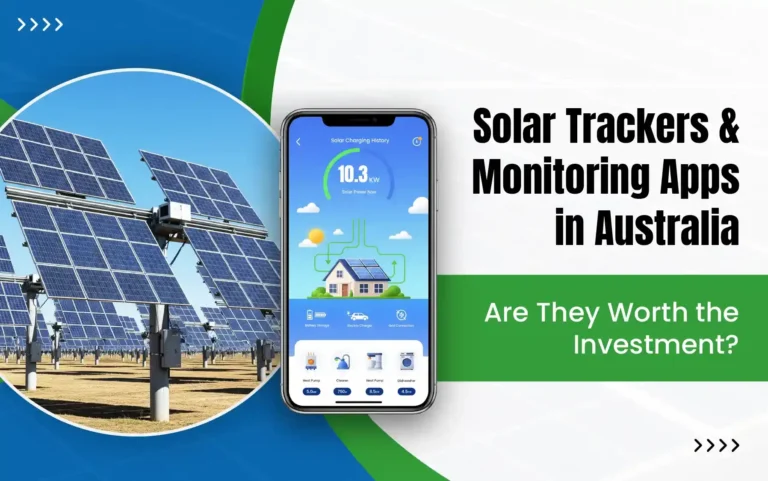
Strong irradiance and rising electricity prices have driven increased deployment of solar energy systems and advanced solar technologies within Australia. Therefore, in Australia’s mature solar market, the emphasis has shifted from just panel installation to system optimization. Advanced technologies include solar tracking systems and accessible energy monitoring applications. Generally, these solutions promise higher energy generation, improved system visibility, and enhanced performance control, though at additional capital and operating costs.
Therefore, this blog outlines how solar trackers and monitoring applications work, their advantages and disadvantages, and whether these tracking devices represent a good investment in the Australian solar market.
What are Solar Trackers
To evaluate solar tracking systems, it is essential to first understand how solar tracking operates. A solar tracking system is a mechanical structure that moves photovoltaic panels to track the sun’s position throughout the day. Unlike fixed-tilt systems, trackers dynamically respond to the sun’s position, increasing solar exposure and energy generation.
Let’s see the two primary configurations.
- Single-Axis Trackers: These systems rotate solar panels around a single axis-typically east to west- following the sun’s daily path to improve energy generation.
- Dual-Axis Trackers: These systems adjust both horizontally and vertically, allowing precise alignment with the sun’s position throughout the day and across different seasons.
Under Australian conditions, solar tracking systems can therefore improve energy generation according to location, system size, and type of tracker used.
Read Also This: Ground Mounted Solar Panels: Pros, Costs & Setup
Solar Trackers: Benefits and Drawbacks
Advantages
- Higher energy yield compared to fixed systems
- Improved system efficiency in the early morning and late afternoon
- Strong performance advantages for large commercial and utility-scale installations
Disadvantages
- Higher installation and equipment costs
- More maintenance, since they have moving mechanical parts
- Unsuitable for most residential rooftops due to structural load limitations and space constraints.
- Requires more land as well as structural planning
Solar trackers offer measurable benefits, but the value is highly dependent on system scale and operating conditions.
What are solar tracking applications?
Solar monitoring applications represent digital systems that provide real-time visibility into solar system performance. These applications connect with the inverters, meters, and sensors to track system behaviour constantly.
What they do-
- Display energy generation and consumption.
- Identify faults, shading, and grid interruptions.
- Track ROI and environmental impact.
Therefore, in other words, energy monitoring provides system owners with data-driven control over how their solar assets perform.
Advantages of Energy Monitoring in Solar Systems
Energy monitoring applications offer practical operational advantages across all system sizes.
Operational Efficiency
Energy monitoring allows quick detection of underperformance, shading, inverter faults, or grid interruptions. Early detection reduces downtime and energy losses.
Performance Optimization
By analyzing generation and consumption patterns, system owners can optimize load schedules, storage strategies, and export behavior for maximum solar utilization.
Financial Transparency
Monitoring platforms also quantify system return on investment (ROI), assess the impact of electricity tariffs, and support informed decisions around system upgrades, battery integration and participation in demand response programs. In addition, advanced monitoring solutions now analyse electricity retailers’ plans and automatically identify more competitive Feed-in tariffs, enabling users to switch retailers and maximise export revenue with minimal effort.
Consequently, unlike solar trackers which are basically suited to large-scale installations, energy monitoring platforms are applicable across residential, commercial as well as industrial systems. By combining performance insights with tariff optimisation, energy monitoring has become a vital component of modern solar installations and a clear value-driven investment.
Read Also This: How to Maximise Your Business ROI with Government Energy Rebates
Costs Involved
Solar Tracking Systems
- Higher upfront equipment and installation costs
- Ongoing maintenance and servicing requirements
- Additional costs of engineering and land preparation
Energy Monitoring Apps
Energy monitoring platforms are typically integrated into modern solar installations and vary in capability depending on the provider and level of analytics offered. These platforms basically fall into three categories-
Good – Manufacturer-Based Monitoring
Basic monitoring solutions bundled with inverters, such as Sungrow (iSolarCloud) and SOFAR, provide real time performance data at no additional cost. These platforms therefore primarily focus on energy production and system status.
Better – Premium Manufacturer Platforms
Advanced monitoring provided by manufacturers such as SolarEdge and Fronius delivers deeper performance insights, including panel-level monitoring, fault detection and enhanced system diagnostics.
Best – Independent Analytics Platforms
Third-party solutions such as Solar Analytics extend beyond performance monitoring by incorporating financial analysis, ROI tracking and automated electricity plan and Feed-in Tariff optimization. Hence, these platforms may need a low-cost subscription but provide significantly higher value through ongoing cost savings and energy optimisation.
Are solar tracking systems and monitoring applications justified expenses for Australian consumers?
These are the questions at the heart of the matter, with the answer varying by the scale of the system, the intentions, and the cost.
Commercial and Utility-Scale projects
For large solar farms and commercial installations , tracking systems deliver measurable increases in power output and projects’ economics. Together with advanced energy monitoring, you can look forward to even more power output along with improved operational insights, including grid conformity.
Home solar installations
For most home installations, a fixed tilt solar installation combined with energy monitoring is the most beneficial. It provides the best balance of value for money and performance. It would be very resource-intensive to use solar trackers on a roof.
Strategic recommendation
- Solar Trackers – Best suited for large, ground-mounted or commercial solar installations, where the additional energy yield can justify the higher capital and maintenance costs. In the Australian market, solar trackers remain a premium solution, typically viable only for large-scale projects or properties with substantial land availability.
- Energy monitoring – an absolute requirement for all types of solar energy systems. Unlike trackers, energy monitoring delivers universal value across residential, commercial and industrial installations. Moreover, in Australia, advanced monitoring platforms enable ongoing performance visibility, fault detection, and electricity bill optimisation. Even a high-end monitoring app with an annual subscription of approximately $60 can help a typical homeowner achieve savings of up to $400 per year through tariff optimization, representing a clear 600% return on investment.
Read Also This: Battery Energy Storage Systems (BESS) Solution
Future Outlook for Advanced Solar Technologies
While Australia pushes for greater renewable penetration, smart solar infrastructure will steadily move to center stage. Solar assets are bound to perform better with advances in AI-powered energy monitoring, predictive maintenance, and hybrid tracking and control systems. The value of “real-time” system intelligence will rise through tighter integration with battery storage, smart grids, and virtual power plants.
Conclusion
Solar Tracking systems and energy monitoring have two unique functions within the process of maximizing a solar system. Solar Trackers enhance the sunlight that reaches solar panels and increase overall production, while solar monitoring platforms ensure that everything works well.
It is primarily essential to invest in energy monitoring in Australia. The benefits of energy monitoring through this point in time include performance observation in real time, identification of issues in a short period, and improvement of finances. Such benefits stand to be lost if energy monitoring is undertaken. Issues related to the energy system breakdown inverter quirks, and communication breakdown could remain unnoticed for several months if energy monitoring is not done.
Therefore, energy trackers are most appropriate to use on larger projects where the additional energy expenditure is worthwhile. However, on small systems or while weighing costs and benefits, it would be appropriate to carry out further research before making a final decision.

- How to Pick the Right Battery Type for Your Solar Lifestyle - March 21, 2026
- Victoria’s Cheaper Home Battery Rebate Program: Everything You Need to Know - March 11, 2026
- How to Calculate the Ideal Solar System Size for Your Home in Australia - March 7, 2026