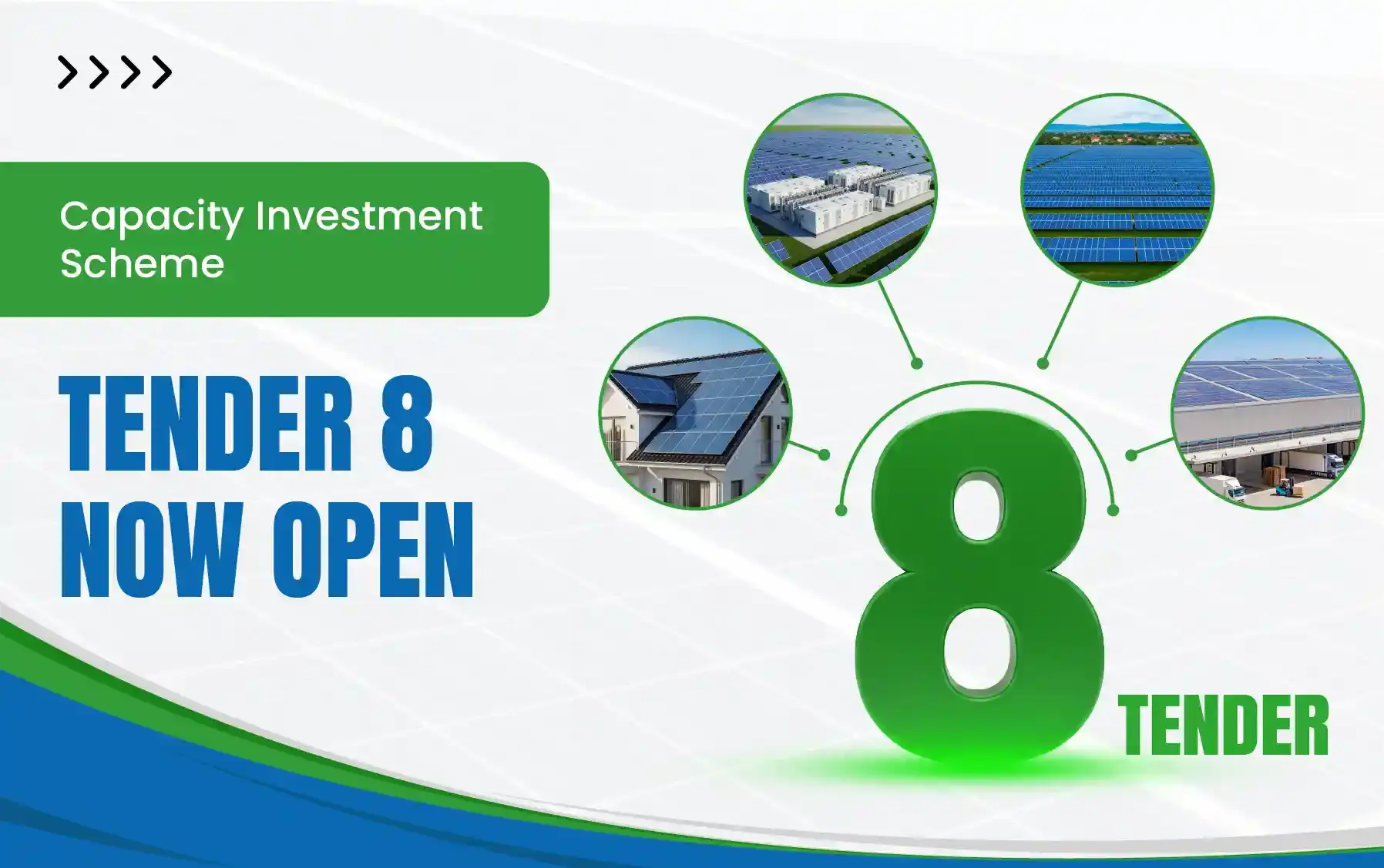
Finally, Australia’s energy sector is taking another step towards a sustainable and reliable power future with this grand opening of Capacity Investment Scheme Tender 8. Tender 8 is now officially open, inviting participation from eligible stakeholders to participate in building firm and dependable electricity capacity that can actually support the country’s transition to cleaner energy.
Also, with this new scheme the investors and stakeholders have gained renewed attention from energy developers, investors, and also to industry stakeholders. Moreover, by encouraging investment in projects such as battery storage and other dispatchable power solutions, the Capacity Investment Scheme further aims to ensure electricity remains available during periods of high demand and low renewable generations.
The most important thing is the how much watt is being provided so as we all know that Tender 8 of the capacity Investment Scheme (CIS) for the National Electricity Market is now open, and most importantly this round will add 16 gigawatt- hours (GWh) of clean, dispatchable energy storage, such as batteries, to the NEM. Well, in simple terms we can say that is enough power to the peak load of 3.7 million homes for 4 hours.
Understanding the Capacity Investment Scheme
First we need to understand the CIS before diving into Tender 8, we need to understand why it is important to understand this properly. So, the Capacity Investment Scheme is a very competitive tender process that provides revenue underwriting, in other words it is a form of long-term contract which is generally used to reduce the financial risk for new renewable energy generation and clean dispatchable capacity projects.
Furthermore, it is also true that renewable energy is clean but it is not always available when demand is high. The capacity investment scheme addresses this issue by encouraging investment in technologies that can provide dispatchable capacity, meaning power that can be delivered whenever it is needed the most.
If we split in more simple terms-
- Electricity supply remains reliable
- Power shortages and blackouts are avoided and overcome
- The final and most important point is investors can finally receive a long-term certainty to build and maintain essential energy assets
Why CIS is Important and Necessary?
The scheme is important and necessary due to various reasons, and also it was established due to two major challenges which are as follows-
- Coal Retirement- Well, in this it means, a significant portion of the National Electricity Market coal-fired generation is retiring, creating a large reliability gap that needs to be filled quickly.
- Renewables Integration- It is true that though Australia has a lot of abundant wind and solar resources, these sources are variable. To ensure grid stability and reliability, this variable generation must be backed up by dispatchable capacity- energy storage that can be turned on when needed.
Read Also This : Battery Energy Storage Systems (BESS) Solution
Aggregated Projects: A Game-Changer in Tender 8
What Are Aggregated Projects?
Think of aggregated projects as the "strength in numbers" approach to energy. In the past, tenders were dominated by massive, standalone facilities. Tender 8 changes the rules by introducing a smarter way to bid.
Instead of needing one giant asset, developers can now combine multiple independent projects such as separate battery storage systems across different locations into one unified proposal. As long as these projects work together to deliver a total capacity between 5 MW and 30 MW, they qualify. It allows dispersed, smaller assets to act as a team, providing the National Electricity Market (NEM) with the same reliability as a large power plant, but with added flexibility.
How Smaller Developers Can Finally Compete?
This is the open door that smaller developers, commercial businesses, and renewable startups have been waiting for. Previously, the "scale barrier" effectively locked out anyone who wasn't an industry giant. Tender 8 removes that obstacle.
For the first time, you can bundle smaller battery and dispatchable energy assets to meet the eligibility criteria. This gives smaller players access to the same government-backed revenue certainty that was once reserved for the big end of town. This shift is vital it drives competition, encourages local innovation, and ensures that Australia's energy transition is built on a diverse, resilient network of businesses, rather than just a few monopolies.
Importance of Tender 8 for Investors and Developers
Well, it’s quite an important and necessary topic that is why it is important for investors and developers, it is because Tender 8 offers significant opportunities for investors and developers. One of the biggest challenges in the energy sector is uncertainty around future revenue. The CIS addresses this by offering long-term contractual arrangements.
Benefits for investors include-
- Predictable income streams
- It reduces market risk
- Government-backed contractual certainty
- Increased bankability of projects
So, what happens is all these points make it easier to secure financing and move projects from planning to construction.
Read Also This : How Commercial Batteries Work with Solar Power: A Smart Energy Solution for Businesses
Impact of the Capacity Investment Scheme on Energy Consumers
Now let’s dive into the fact that what will be the main impact of the Capacity Investment Scheme on Energy consumers, so for consumers, Capacity Investment Scheme plays a very vital and important role in maintainable and reliable electricity. By ensuring enough capacity is available CIS majorly helps in preventing price spikes during peak and demanding periods.
So, therefore in the long run, CIS contributes to stable electricity prices, also to fewer power outages, a smooth transition to renewable energy and a proper and improved energy security.
Lastly, the consumers may not see CIS directly, but its impact is felt through a more resilient energy system.
How Tender 8 Supports the Energy Transition
The most important thing to know is how Tender 8 is supporting the energy transition and what is the outcome from that, well let’s know in detail. As we all know that Tender 8 is opened in Australia and is designed to support cleaner energy solutions while maintaining reliability. Moreover, it recognises that while renewable energy is essential, additional capacity mechanisms are needed to balance the grid.
Through CIS, governments can-
- Accelerate and improve the renewable integration
- Support the innovation in energy storage
- Build a future ready sustainable energy system.
Conclusion: A pivotal point why Capacity Investment Scheme Tender 8 Matters
Well, in the overall blog content we discussed how Australia had opened a new system known as Capacity Investment Scheme Tender 8, which is helping them to go ecogreen. So, in conclusion we need to represent a crucial step in securing the future of energy supply. By encouraging investment in reliable and flexible capacity, the schemes ensure that energy systems remain strong during the transition to cleaner power sources.
For policymakers, investors, and consumers alike, CIS Tender 8 highlights the major importance of planning ahead, also to balancing with reliability, and most importantly, building an energy system that can meet future challenges without any problem and with confidence.
Key Takeaways: CIS Tender 8 at a Glance
- OFFICIAL STATUS:Tender 8 is Now Open
- Registration Deadline:23 January 2026
- Bid Deadline:6 Februray 2026
- THE SCALE:
The tender seeks 16 GWh (4 GW) of clean dispatchable capacity. To put this in perspective, that is enough energy to power 3.7 million homes for 4 hours. - THE BIG CHANGE:
For the first time, Aggregated Projects are eligible. Bids comprising multiple smaller projects (totaling 5–30 MW) can now participate, opening the door for smaller developers and businesses.
THE FINANCIAL MECHANISM:
The CIS uses Revenue Underwriting (not grants). This provides a government-backed floor price, minimizing risk for investors and making projects "bankable." - THE ECONOMIC IMPACT:
This tender is part of a broader scheme that has already committed to delivering over $37 billion in economic and social benefits, driving job creation and regional growth across Australia. - THE GOAL:
To plug the reliability gap left by retiring coal plants and ensure the grid remains stable as Australia races toward its target of 82% renewable energy by 2030.
At EcoGreen Australia, we believe that the Capacity Investment Scheme is more than just a policy update, it is a vital roadmap to our country’s sustainable future. By empowering businesses of all sizes to invest in dispatchable storage, we are not only securing our energy grid but also protecting our environment for generations to come.