Solar power is an efficient way to use solar energy, especially for commercial sectors. Solar panels on a commercial facility’s roof generate electricity from Sunlight and provide businesses with energy independence. However, if your commercial facility is only using this generated power for operational needs, you are not using solar power on its full potential. Without storage, the flow of solar energy into your systems can be used only when the sun shines, often peaking midday when operations may not need it most. The rest of the energy or excess solar power goes back to the grid at low feed-in tariffs. These feed-in-tariffs could be as low as 5-10 cents per kWh because of non-peak hours.
There are many ways you could use solar energy for your business and maximize your benefits. One benefit is to use the excess energy. When you integrate your solar panels with commercial batteries, you can not only store the excess energy but also use it in many ways. Let EcoGreen Australia show you how commercial solar batteries work with solar power and make a smart energy solution for businesses!
Commercial Solar Batteries
Clean energy investments are becoming smarter, and now they are going beyond usual solar panel investments. Nowadays, clean energy investment means including all those green renewable energy solutions that enhance clean energy motives. That’s why businesses are investing more and more in smart battery storage systems and gaining energy independence, reducing their energy bills and reducing their operational costs.
Usually, people think that solar batteries can only be used as a backup generator, which is quite wrong. On the other hand, when commercial facilities integrate solar batteries in their infrastructure or add them to their rooftop solar installation, the battery storage provides them with complete control over how and when energy is used. Let’s see how!
- Instead of sending excess solar energy to the grid at midday for minimal return, smart battery storage stores that energy to power evening operations.
- You can use this excess energy during peak demand hours when electricity costs are highest. Hence, you can save more money on the energy bills.
- Battery storages provide you with instant backup during outages, blackouts, and ensures zero disruption in your business operations.
- You can sell excess energy back to the grid when there is peak demand and earn thousands yearly.
Integration of Commercial Batteries With Solar Power
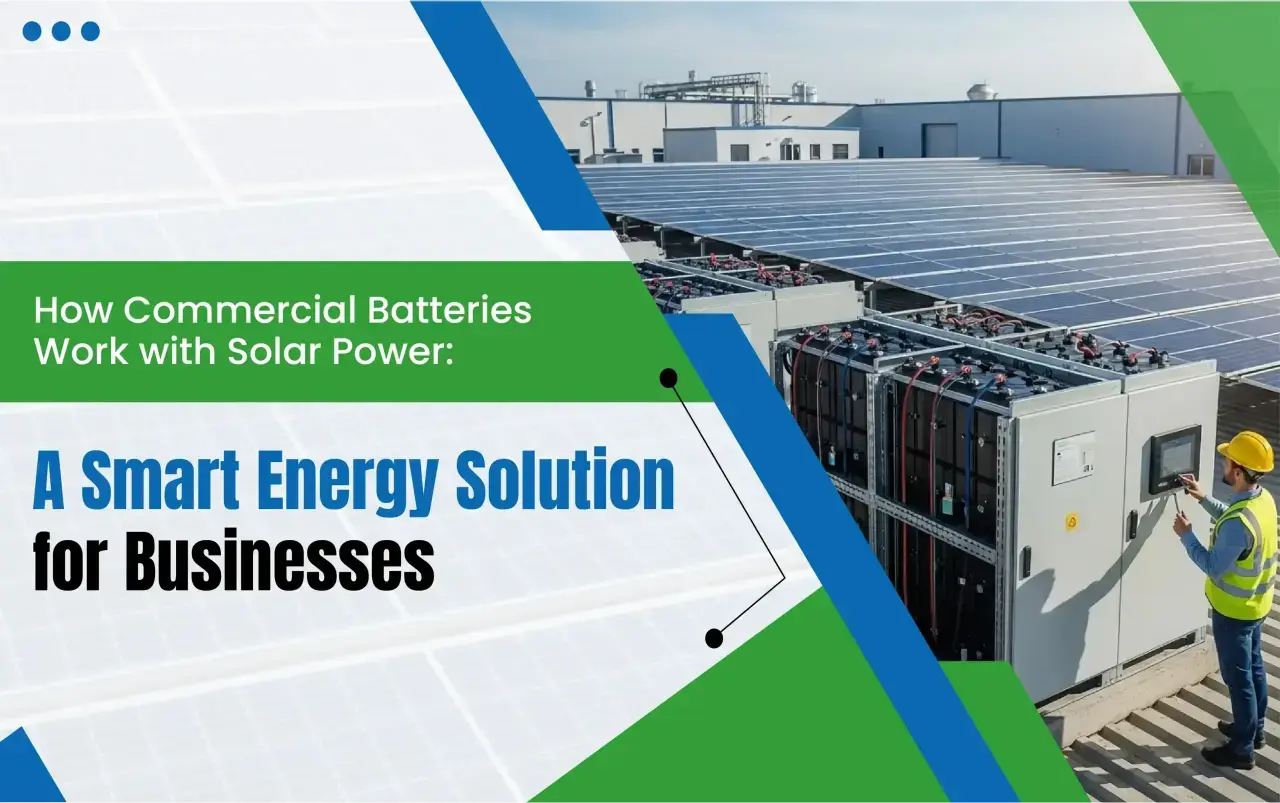
Using solar power with commercial batteries boosts its efficiency, because as we discussed earlier that without a battery, excess solar energy will be sent back to the grid and hence, you get minimal returns. But with battery integration, that excess energy can be stored and can be used later. This means businesses can use this stored energy during evening operations, peak tariff periods, or in case of grid outages or blackouts. This smart and simple integration makes solar from a daytime-only aspect into a complete energy solution.
| Aspect | Function |
|---|---|
| Solar PV Array | Converts sunlight to DC electricity |
| Hybrid Inverter | Converts DC to AC, Manages solar, battery and grid flow |
| Solar Battery Systems | Stores excess solar energy |
| Energy Management System (EMS) | Intelligent and smart control software for optimization |
| Metering & Monitoring | Tracks energy flow, savings and performance |
| Backup Switch | Enables islanding during outages |
Commercial Battery Rebates Are Making it Easier!
We know how frequent power outages can disrupt business operations. Not only do they put a momentary pause in operations, damage productivity, and increase costs for running a business. Since Australia already faces more extreme weather and grid instability, businesses are investing in commercial battery storage. It is one of the smartest moves a business can make to gain true energy independence. Nowadays, there are certain advanced battery systems that store energy from solar panels or the grid, and can protect your company’s operations during blackouts. With the latest commercial battery technology, Australian businesses can reduce reliance on grid electricity.
In 2025, businesses are gaining benefits from federal battery rebates that reduce the upfront costs by up to half. Therefore, integrated solar-plus-storage systems are becoming affordable than ever. Let’s see how the process works!
- You can reduce nearly half of your solar installation expenses with the state rebate, hence, it lowers your capital outlay further, along with federal battery rebates.
- You can get assistance with Clean Energy Council-accredited service providers who apply the rebate directly to your installation invoice. Hence, you can claim instant discounts on upfront costs and also negate the extra hassle and complicated paperwork for your business.
- Solar energy with integrated battery storage will reduce your operational electricity bills further.
- Since the government rebate is for all commercial properties (valued under $3 million), with additional federal incentives, every business can benefit from incentives and get a unified system (solar+battery) for your commercial facility.
With the federal battery rebate providing businesses with up to half off upfront and installation costs, the economics have shifted. Now, Australian businesses are no longer choosing between solar and storage; they are opting for them as a unified system.
Let’s Make Energy Needs Simpler!
EcoGreen Australia designs these integrated solutions with easy customization, precision, matching battery size, and control logic to your business’s load profile. With customized solutions, your business can maintain uptime during outages and even participate in Virtual Power Plant or VPP programs for additional revenue. Energy investments have already become simpler due to the ongoing government incentives or rebates. The declining battery costs are making energy security more accessible than ever. Therefore, protecting your business from unpredictable power disruptions has never been easier.