Have you ever wondered how businesses are earning $500 to $2,000 for every 100kWh of battery capacity every year, simply by letting the grid use their stored energy when needed? Do you already have a commercial battery and feel it is sitting idle for most of the year? And what if your battery could do more than only provide backup, while actively earning money and supporting the energy network?
This is where the discussion about virtual power plants starts. Businesses in Australia are tactfully converting their battery systems into assets that generate income. These systems are being linked, coordinated, and optimised to support the grid during periods of high demand and instability rather than functioning independently. This collective network is referred to as a virtual power station. Although it sounds complicated, the concept is surprisingly useful. Follow along for a deeper dive.
What Exactly Is a Virtual Power Plant?
Individually, one battery helps one business. Collectively, thousands of batteries can stabilise the grid, reduce strain during peak demand, and prevent outages. In return, commercial entities are rewarded for participating. Sounds fair, right?
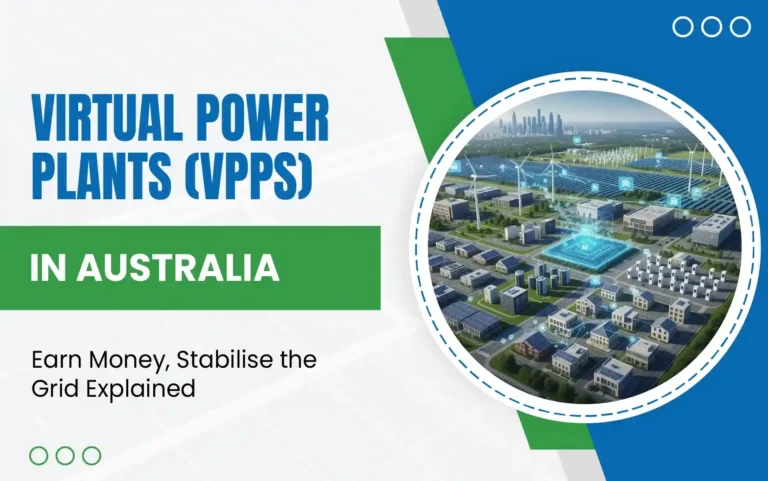
A Virtual Power Plant, or VPP, is not a physical power station. It is a digitally connected network of distributed energy systems, including solar panels and commercial batteries, that function together as one coordinated energy resource. Each business continues to use its existing systems without any disruption, while the battery remains available to support operations during power outages. The difference is that during demand periods, small amounts of stored energy can be shared with the grid in a controlled way. Think of it as teamwork for energy.
Why Australia Is a Perfect Fit for VPPs
The energy landscape here makes VPPs not just useful, but necessary.
In Australia, businesses have:
- High solar adoption
- Increasing grid pressure during peak demand
- Rising electricity prices
- A strong push toward clean energy
At the same time, more businesses are installing solar and battery systems to save costs and boost resilience. VPPs bring these elements together. Instead of building more fossil fuel power plants to manage peak demand, the grid can rely on existing batteries spread across businesses. This makes energy cleaner, smarter, and more flexible.
How Companies Really Make Money With VPPs
The majority of people want clarification on this particular aspect. Your battery can offer grid services like the following when it takes part in a VPP:
- Providing energy when demand is at its highest
- Encouraging frequency control
- Reacting promptly to grid instability
Grid operators and energy markets pay for these services, which makes them valuable. Depending on market participation, battery size, and usage patterns, this usually translates into annual earnings for businesses of between $500 and $2,000 per 100kWh of usable battery capacity. Most importantly, participation is automated. You don’t have to monitor markets or operate your system. It is managed in the background by technology. Yes, your battery generates revenue while you concentrate on managing your business.
How Commercial Batteries Fit into VPPs
Not all batteries are the same. Commercial battery systems are particularly valuable for VPP participation because of their size and capability. This makes commercial facilities ideal participants, especially when paired with on-site solar generation.
Larger battery systems:
- Provide more meaningful grid support
- Earn higher annual returns
- Respond faster to grid signals
- Support business-scale energy needs
Does VPP Participation Affect Backup Power?
This is a common concern, and a valid one. The short answer is no, when designed properly. Commercial battery systems are configured with clear goals. Backup power for your operations is always prioritised. Only excess capacity is made available to the grid, and only within defined limits.
If a grid outage occurs, the system responds instantly to protect your facility. VPP participation never compromises reliability. That balance is important, and it is why correct system design and control logic matter.
The Business Benefits Go Beyond Direct Earnings
While the additional revenue is attractive, VPP participation delivers more than just payments.
- Lower Effective Payback Periods: By earning income from grid services, businesses reduce the payback period of their battery investment. The system starts paying for itself more quickly, thereby improving its overall ROI.
- Reduced Exposure to Peak Costs: Batteries already help reduce peak demand charges. VPP optimisation takes this further by intelligently managing when energy is stored, used, or exported.
- Improved ESG and Sustainability: Supporting grid stability with clean energy directly contributes to emissions reduction. For businesses reporting on sustainability, this adds measurable impact.
- Stronger Energy Resilience: VPP-enabled systems are often paired with advanced monitoring and controls. This improves visibility and system performance over time.
Understanding Grid Services in Simple Terms
When the grid is under stress, it needs help fast. Batteries are perfect for this because they respond in milliseconds. Your battery does small tasks many times. Individually, they seem minor. Collectively, they keep the grid stable. And the grid pays for that reliability.
Grid services can include:
- Supplying power during peak demand windows
- Absorbing excess energy during low demand
- Stabilising frequency when supply and demand fluctuate
How Rebates and Incentives Fit Into the Picture
In states such as Victoria and Queensland, solar and battery incentives significantly reduce the upfront costs, as government incentives play a big role in making batteries more accessible. When combined with VPP revenue, the economics become even more attractive.
However, navigating eligibility, compliance, and documentation can be complicated. This is where expert guidance becomes irreplaceable. Done correctly, incentives and VPP participation work together to maximise financial and operational outcomes.
The Bigger Picture: Why VPPs Matter for Australia
Every participating business becomes part of a larger solution. And that contribution is measurable, not symbolic. VPPs are not just about individual savings. Isn’t that a better way to think about energy investments?
VPPs with effective battery systems help:
- Reduce blackouts
- Lower reliance on fossil fuels
- Defer expensive grid upgrades
- Support Australia’s clean energy transition
Conclusion
When designed correctly and managed by experienced professionals, VPP participation turns stored energy into ongoing value, without disrupting daily operations.
For businesses ready to unlock this next level of energy performance,
EcoGreen Australia
delivers end-to-end
commercial solar
and battery solutions, expert rebate management, VPP-ready system design, and performance support to help you future-proof your energy strategy.

- How to Pick the Right Battery Type for Your Solar Lifestyle - March 21, 2026
- Victoria’s Cheaper Home Battery Rebate Program: Everything You Need to Know - March 11, 2026
- How to Calculate the Ideal Solar System Size for Your Home in Australia - March 7, 2026